Dear Partners,
It has been a tremendously joyful and fulfilling experience to deliver returns to all of you during the past 2 years of the Fund’s existence. I get to do what I love with people I enjoy working with. It doesn’t get much better than that.
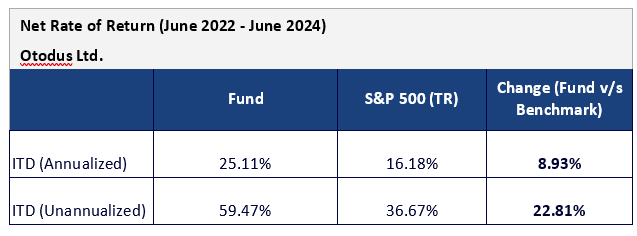
Below is a compa rison of the Fund’s net returns (after performance fees and expenses) versus the S&P 500 Total Return index (as if dividends had been reinvested):
I probably sound like a broken record by now, but our mission remains the same: to beat the average stock market over a long-term period.
Why is it so difficult to “beat the market”?
I believe it boils down to 2 reasons:
- It is really hard, emotionally, to buy a stock when nobody believes in your reasoning (much like the initial days of building a new company). Human beings are genetically wired to follow the crowd, and it’s really tough to buy a stock when it’s getting clobbered, even when you know it’s a great company, with a solid balance sheet, and selling at a ridiculously cheap price;
- Most people cannot bear the stress and volatility of a concentrated investment portfolio.
That’s what you pay us for.
Does that mean we invest in stocks just because prices are falling? No. Shitty companies with lousy managements, bad business models, and terrible balance sheets can destroy invested capital in an instant.
It does mean, however, that when we’ve done a lot of due diligence, understand a company’s fundamentals, the balance sheet is solid, and prices are cheap, we go for the kill. We’re aggressive.
One of my all-time favorite quotes, from The Autobiography of Andrew Carnegie and the Gospel of Wealth, explains much of our reasoning:
“The concerns which fail are those which have scattered their capital, which means that they have scattered their brains also. They have investments in this, or that, or the other, here, there and everywhere. ‘Don’t put all your eggs in one basket’ is all wrong. I tell you ‘put all your eggs in one basket, and then watch that basket.’ Look round you and take notice; men who do that do not often fail. It is easy to watch and carry the one basket. It is trying to carry too many baskets that breaks most eggs in this country. He who carries three baskets must put one on his head, which is apt to tumble and trip him up. One fault of the American business man is lack of concentration.” - Andrew Carnegie
In essence, every stock is really just a bond. The yield of a stock is harder to determine than a bond because a company’s earnings can grow or shrink, but its intrinsic value is all of the cash that you can get out of it minus all of the cash that you put in, compared to other investment opportunities and the risk-free interest rate.
Therefore, if you can get an approximation of the normalized net income & free cash flow that a company will generate now and into the future (growth counts too) and relate that to its total market capitalization (its price), it becomes much easier to estimate the yield that your investment will generate. This estimate of intrinsic value should obviously also include other important metrics such as tangible book value, debt/liquidity, and intrinsic business/economic risks.
We are still in the very beginning of a lifelong race, and it will be a pleasure to keep compounding your capital by making the best investment decisions we deem possible.
Here’s to many more years to come.
Sincerely,
Lucas Koelle
Managing Partner
Otodus Global LLC